Tuesday, April 06, 2010

Biz Strategy

Risk Management and Business Realities
How attitude shapes models in forecasting

Markets are able to digest and take into account both good as well as bad news. However, markets are not able to digests or tolerate uncertainty. The uncertainty as to the causes and effects of the current global economic slowdown coupled with the uncertainty as to the right action that needs to be taken by governments, businesses and consumers to remedy the economic weaknesses that exist continue to make forecasting of business risk clouded by data which does not seem to fit into accepted risk modals.

Perhaps there is an element of truth in George Soros’s contention that markets are shaped by alchemy, as we realize that business decisions are very often made without all the facts available for risk analysis. As regulatory frameworks for financial systems converge globally, ideology or attitude may increasingly distort outlook and therefore financial and commercial decision making.

Risk forecasting used to be relatively straightforward. Utilizing the first quarter financial and sales figures, managers could quite reliably predict how the business was developing and whether targets could be met, missed or exceeded. Confidence in such predictions reached a point where any deviation above or below the predicted figure could impact share value positively or negatively depending on the figures.

The uncertainty in the direction of the global economy has shaken confidence in such market projections. This increasingly results in an unwillingness of managers to make predictions of risk and could lead to a paralysis in the conduct of business. Standing still is not an option for businesses and decisions have to be made for continued business success.

The core issue is in understanding and managing risk. There is no guarantee of success for every business decision made. The complex models for evaluating financial and commercial risk need to be re-examined. The variables of possible and probable outcomes based on historical performance appear not to have predicted or prepared companies for the present global economic slowdown. So do we need to redesign these risk models? The models may not have failed us rather the internal attitude or corporate culture may have been to ignore information in the euphoria of a booming global economy that seemed on a forever upward trajectory. Free markets appeared to have freed businesses from national economic regulation that was seen as an out-dated socialist ideological burden. But free markets cannot mean a free for all leading to recklessness.

Companies may as a consequence have to re-examine historical data that went into their risk management modals with a fresh focus on the ethics of how information and data was evaluated for risk. Ideological distortions have no place in the market. Ideals of social responsibility and market efficiency in delivering what the consumer wants need to be fed into the risk management modal. When an assumption changes, risk evaluation must take it into account.
An approach taking into account “sovereign risk” based on the political ideology prevailing in a nation state such as socialism in Venezuela, as well as “operational risk” where internal operational disputes can affect performance as in the case of delays in the launch of the 380 jet by Airbus will help us understand how ideology and social relations impact on business risk.
An important factor to note is the fact that financial traders, economist, politicians and academics may think differently about risk than a manager in the commercial world of global trade in goods and services. There is a need to understand risk in a more holistic framework rather than in compartments such as operational risk, market risk and credit risk.

It must be accepted that risk taking is what all of business is about. Business is about succeeding more then failing. One has to dare to succeed and information about markets and finance need to be understood in terms of probabilities of success. How we predict probabilities under uncertain economic conditions is the challenge.

We therefore need to construct a new global risk architecture within which prevailing models can better operate to help us predict the best course of action for the company and the probability of success. Factors such as increasing speed of flow of information, increasing access to information and the increasing interconnectivity of regions that transform the world into one giant market place need to be digested and taken into account in making business decisions.
We may need to move from an “industrial age” to an “information age” risk management approach of evaluating “internal organizational risk” within the context of “worldwide industry risk” to fully appreciate the impact of global financial realities on markets.


Thursday, December 31, 2009

Business Strategy

Canada's Asia Pacific Gateway                                                           
An opportunity for business champions.

Canada is an affluent, multi-cultural high-technology industrial society with a trillion dollar economy which resembles the US in its market-oriented economic system, pattern of production, and affluent living standards.
With abundant natural resources, a highly skilled work force, and capital resources, Canada is seen to have sound economic prospects.
Vancouver on the Pacific West Coast has a dynamic and diversified economy. In 1989 Vancouver approved a USD1.7 billion development by Hong Kong billionaire Li Ka-shing. The waterfront project for the site of the 1986 World's Fair has transformed the skyline of the city. For the vibrant economies of the Asia-Pacific Vancouver acts as a gateway to the worlds’ largest market, North America.
Winnipeg located in the geographical Centre of Canada facilitates efficient transportation and distribution to all North American time zones. It has one of the lowest overall business costs of major North American cities.
Amongst the G8 countries Canada ranks first for; best overall quality of life, a land of equal opportunities, lowest cost of living, safest place to live, and, best human development
Canada wants skilled and professional individuals from all over the world. There is a recognition that the Canadian society is "aging", hence the need for talent from outside Canada.
The opportunities for business investment in Canada remain great with its’ North America Free Trade ties to the United States of America and Mexico enhancing its’ links to the Asia Pacific Economies.

Thursday, December 24, 2009

Business Strategy

The Crumbling Worldwide Wall
How global traders scale local market barriers

“All in all it’s just another brick in the wall” … as the lyrics of the Pink Floyd song goes, walls are built one brick at a time. The Berlin wall came down on 911 (9th November) symbolizing the advent of global free trade. So, all this talk brick by brick of rhetoric on buying local to save the local economy; will only result in a trade wall keeping out the wealth of the global market from local economies.
As both domestic and global markets contract, the marketing strategy should be, to carve out a niche in the wider global economy so that the net effect will be more trade and bigger profits. For many countries worldwide, the year 2008 has seen both exports and imports down. Companies that can transcend protectionist tendencies will find global trade the logical way to ensure growth.
“Buy a made in Asia $99 DVD player instead of an imported ‘high tech’ $999 one”, so the rhetoric goes. Are the European Union, North America and Japan creating a technology trade barrier by insisting on environmental and safety standards that require more sophisticated technological innovation? The simple answer is there is a market for both the latest in technological advancement which will cost more and for the lower priced old technology version of the product. If we let the global market sort it out, we will find in all countries of the world consumers who can afford the particular product depending on the economic niche the product appeals to. So, targeting the right niche globally is a strategy worth exploring.
Visit any North American departmental store and you will find products made in China. The consumer is more focused on fulfilling his or her needs and desires rather that staying focused on brand loyalty. The brand is more a convenience for identifying function and quality assurance. This allows new innovative products from smaller companies to find a niche in the consumer market.
Look at the iPod phenomena. It has been more of an individual, Steve Jobs and his innovation team rather then brand Apple that made it a success. This, suggest that a single product capturing the imagination of the consumer can come to dominate a new niche in the market. The same can be said for the Canadian Blackberry mobile phone.
A product when promoted through an effective supply chain can deliver to consumers worldwide at prices that translate into strong sales. An interesting case of global expansion is the Japanese clothing brand UNIQLO which started operations in 1984. Their strategy has been, to offer high quality casual wear at relatively low prices. The company benefited from the boom across Japan in 1998. A fall in revenue after this period was arrested with an expansion of women’s wear products. Subsequently, the company expanded across Japan and internationally into the United Kingdom, the United States, and China and now, with the current global economic slow down expansion continues into other Asian and East European markets.
The lessons we learn from such companies include the importance of investment into research and development of markets worldwide in order to ensure that products are tailored to local taste. The idea is to go global by serving local needs and demands. Small and medium sized industries can take advantage of market data and statistics available through government agency websites at national, provincial and city levels of target countries. A virtual business networking site can connect businesses worldwide and provide links to such government agencies through a web of connections.
Test marketing a product in the right city before expanding into the rest of the country makes perfect sense. Market studies as to which city to be selected for initial entry and which cities are to be considered as trend cities for subsequent expansion will allow for a natural growth of market share.
Quality assurance is another factor in building market acceptance. Being transparent as to how quality control is maintained in the form of insistence on quality ingredients and safe production processes is critical in creating confidence. If production is located in a third country then the systems put in place and information on the competency of employees need to be made as transparent as possible.
Having your own signature store or an established retail departmental store as your distributor in an established market such as Canada, Europe or the United States can establish consumer confidence better than any brochure or sales presentation of success in a developing economy. It is time to do the market research to expand your market share and increase sales by going global.

Siddha Param

http://worldwidebusinessconnection.com/

Thursday, December 03, 2009

Business Strategy

Business Planning In An Uncertain Economy

Advantages of integrating continuing learning into the matrix

If GM could get it so wrong for so long then what chance do other businesses have in uncertain times? It is now a global economy and an increasingly borderless world for trade. We therefore have to expect that there will be suppliers of goods and providers of services who will trade worldwide. Increasingly, it is quality and value for money that is shaping markets more then loyalty to traditional national brands. Understanding what the consumer truly wants is critical to strategic business planning.

The business that better understands more of the variables that go into shaping consumer demand will be the one to pull ahead and over-take the competition out there. It has always been the team with the better strategy that wins.

It is therefore critical for a winning business plan to include a process for acquiring market information for analysis as to changing economic conditions. The business plan must set out a mechanism for processing this information into useful knowledge that can be utilized to make decisions on whether the product or service offered meets consumer demand, needs to evolve or be abandoned. Built into the plan must be a strategy for learning from both success and failure that can be fed into future product or service innovation and evolution.

A successful business plan must therefore include a strategy to identify a winning product or service as well as a framework for learning from market responses and an ability to innovate to win based on lessons learnt from such responses.

It is important to appreciate at the planning stage that since there is uncertainty in the economy, forecasting what will be the market response cannot be done accurately. In other words the planners have to recognize that they will have to be constantly learning and reworking cost and sales figures as the plan is implemented. This is the continuing life long learning component that must be an integral part of the business planning matrix. The plan should be, to learn and innovate very quickly at a sustainable cost in order to turn a profit at the end of the process. To do this the learning process must help the business evaluate risk and take advantage of business opportunities that emerge.

In many ways this approach to business planning requires applying the mind set of entrepreneurship as opposed to a more business management approach of doing a market study, coming up with a marketing and financial plan with a profit forecast prior to implementation which is based on fixed assumptions with no changing of horses in mid stream. Entrepreneurs know that you have to innovate as you go along implementing a plan because you never know how deep the water is until you get your feet wet and success comes from a willingness to learn on the job.

In uncertain economic conditions a business cannot afford to make too many costly mistakes as markets shrink and the cost of financing increases. Many of the assumptions in a booming economy such as easy access to funding based on reputation and past performance disappear. Past profits may have been based on failures being paid for with cheap funding made available based on projected sales figures calculated on an assumption that market conditions will remain the same. Prediction of impending global economic uncertainty may have been ignored.

Too often, when good times come, behavior changes and too many in business come to believe it will never end. Too much money is spent on expensive lessons and little is learnt about how the profits are actually being achieved.

The key to business success in uncertain times is to create a business strategy unit which will learn lessons from the information generated from the implementation process in a cost effective manner in a very short time frame which can then be fed into innovation that allows the implementers to adapt to the changes on the ground. This approach to planning recognizes that the plan is not based on complete knowledge as not all the information variables are available at any given time of decision making.

Hence, there must be a recognition that figures have to be constantly recalculated and decisions modified with a recognition that all financial targets are approximations. There must also be an exit strategy built into the business plan that indicates when and how a project should be abandoned to avoid excessive losses and how the knowledge acquired in the implementation process can be utilized for a new venture.

Whether GM evolves into Green Motors or a Genetic Mutation that gives us new innovations in transportation will depend on the lessons that come out of the business restructuring plan now underway.

Perhaps the lesson all businesses can learn from the current economic uncertainty is, how to prioritize wants and recognize business needs.

Siddha Param
http://worldwidebusinessconnection.com/events.htm

Thursday, November 26, 2009

Positioning for Global Expansion

The Next Global Economic Upswing!
Taking advantage of the worlds' largest market
 
The Dow Jones has gone above the psychological 10,000 points. Wall Street is back in business. The time has come to position yourself to take advantage of the the worlds' largest market - North America.

Businesses need to identify ways for cost effective market entry. The consumer is looking at value for money. This means marketing strategies must deploy funds more effectively to make every dollar count in promotions and awareness campaigns that convert into sales. 

A strategic entry point into North America is the city of Winnipeg in Canada. Utilizing the web  for market information is a cost effective way of researching a market. For example you can click on a website such as http://www.downtownwinnipegbiz.com/home/business/quick_contacts/ for links to information. However, you may end up with an avalanche of information that results in information overload. A business knowledge coach can help you make sense of this information and help you focus only on the information necessary to prepare your business and marketing plan and strategy. 

Identifying and understanding a market is crucial to business success in the coming economic upswing.

Cutting back on operational expenses while seeking new market opportunities is the challenge in this global economic slow down. The economies of India and China are growing . There is an increasing consumer market in these two countries. But, the fact remains that North America still has the largest consumer base in the world.

Establishing a North American presence whether in Canada or the United States can position your company for future expansion throughout North America. 

Today's global reality is, worldwide business connection through the worldwide web or internet remains one of the most cost effective ways for expanding market share and growing a business. An internet presence is now an essential marketing tool. 

With the advent of mobile internet access, decision makers can and do access information on products and services through that mobile device held in the palm of their hand. 

Business leaders will increasing "fly" to their destination in a split second using  their mobile  phones. The time has come to get connected through "web-lite" virtual business centres  that provide information on markets with knowledge advisers who help you understand the potential of the Asia Pacific economy that links South and East Asian markets with North American markets. 

Siddha Param
http://worldwidebusinessconnection.com/events.htm 

Sunday, November 15, 2009

CORPORATE GOVERNANCE

CORPORATE ETHICAL CONDUCT
A role for corporate counsels

“We are now responsible for delivering legal advice, being effective managers, serving as the conscience of the corporation, and beyond that, giving strategic business advice”.
- Barry Nagler, Chairman, Association of Corporate Counsels, America


Robert Clive’s contributions to the failure of the British East India Company, Nick Leeson the rogue trader forcing the collapse of Barings Bank, and Kenneth Lay’s strategies that resulted in Enron’s demise all suggest that financial audit and risk management systems alone are insufficient in preventing corporate failures.

Michael Power, Professor of Accounting at the London School of Economics and Political Science in his book, “The Audit Society – Rituals of Verification” states, “…the official procedural knowledge base of auditing has evolved in response to scandals and corporate failures in such a way that the essential puzzle of what audits produce – their effectiveness – remains hidden from view as an article of faith.”

The Report on Corporate Governance by the Malaysian High Level Finance Committee states, "The board should receive information that is not just historical or bottom line and financial oriented but information that goes beyond assessing the quantitative performance of the enterprise and looks at other performance factors …"

How do we balance the aspirations of businesses and stakeholders for economic prosperity and justice within the global market place? It has been said that the role of the law is supplementary to insurance and the underlying economic concept of risk management. However, for an equitable and fair market, legal principles must trump both financial auditing and risk management principles in the governance of corporations.

Enron was a corporation that appeared to have all the modern management tools of financial audit, risk management and even a code of conduct. Unfortunately their own internal code was apparently not applied to the transactions that ultimately affected the bottom line.

The stakeholder approach to corporate governance suggests balancing the interest of all stakeholders by considering the potential harms and benefits of a proposed plan of action on each party. The stakeholders should include; directors, managers, employees, shareholders, consumers, suppliers, regulators, and the affected community.

In taking into account the stakeholder during the business decision making process the issues that must be addressed are: legality within the respective jurisdictions of operation; compliance with global industry standards; compliance with standards set by the company’s leadership; and, acceptance of the business decision by the wider community not privy to any resulting commercial contract.

A useful tool for addressing the above is the “Code of Corporate Compliance and Ethical Conduct” (the Code) to focus business decision making and organisational behavior on the necessary standards of care.

The realization must be that a breach of the Code could result in legal liabilities and/or a corporate disaster. The jurisprudence must be that the fundamental rights reflected in the Code must trump business convenience in a global economy.

The in-house lawyer’s privilege may help corporations create “space for privileged, private and confidential advice” for internal self-regulation and solution by the board of directors hence fulfilling the essence of corporate governance.

The US Supreme Court explained the rationale for the attorney-client privilege in Hunt v. Blackburn (1888), observing that the privilege is "founded upon the necessity, in the interest and administration of justice, of the aid of persons having knowledge of the law and skilled in its practice, which assistance can only be safely and readily available of when free from the consequences or the apprehension of disclosure.

In the case of Arthur Andersen LLP v. United States Rehnquist, C. J. in delivering the unanimous decision of the US Supreme Court stated, “The jury instructions failed to convey the requisite consciousness of wrongdoing. …. A “knowingly . . . corrupt persuader” cannot be someone who persuades others to shred documents under a document retention policy when he does not have in contemplation any particular official proceeding in which those documents might be material.” 

This stresses the importance for corporations to have clearly written policies, guidelines and codes that instruct employees on what constitutes right action and behavior.

In the context of the above analysis, the Code could contribute towards the company becoming a self-sustaining and self-regulating centre for human and financial profit with the corporate counsel assuming the role of chief compliance officer to compliment the chief financial officer and chief operating officer in advising the board of directors on corporate governance.   
 
Siddha Param
International Business Consultant

www.worldwidebusinessconnection.com
Your connection to global markets!
Winnipeg, MB, Canada, North America

First written in 2007

Monday, November 09, 2009

Biz News Update


The Eco-green Marketing Strategy
Moving with the growing global trend! 

Go green for health, safety and value for money. Green when linked to a healthy eco-system can become a powerful marketing strategy that translates into greater profits for businesses.. continued

Siddha Param
International Business Consultant

www.worldwidebusinessconnection.com 
Your connection to global markets! 

Winnipeg, MB, Canada, North America

Friday, August 21, 2009

BizNews Up-date

Business Planning Strategy In An Uncertain Economy
Advantages of integrating continuing learning into the matrix

If GM could get it so wrong for so long then what chance do other businesses have in uncertain times? It is now a global economy and an increasingly borderless world for trade.… continued

www.worldwidebusinessconnection.com

Wednesday, August 20, 2008

Launch of WorldwideBusinessConnection.com

WorldwideBusinessConnection.com
Your connection to global markets!

Register your business website link at:
www.worldwidebusinessconnection.com
(Terms & Conditions apply)

CMI CONSULTING SDN BHD has been granted licence to market WorldwideBusinessConnection.com services (WBConnection), a virtual business centre that provides FREE business news, success stories, skills training and links to resources and opportunities that can transform your business into a global enterprise that profits from the modern global economy spanning Asia, North & South America, Europe and Africa.

WorldwideBusinessConnection.com links businesses to businesses and customers/clients through the BizResources and BizOpportunities network.

WBConnection Team of professionals and entrepreneurs constantly promote WorldwideBusinessConnection.com to business minded individuals, through varied promotional medium and events that include FREE talks and presentations for the business community.

We encourage business students and budding entrepreneurs to utilise WorldwideBusinessConnection.com as a resource centre.

We provide International Business Consulting services in the following areas:
Business Negotiations and Documentation
Corporate Governance and Business Structuring
Joint Venture, Agency and Global Business Expansion


Siddha Param
International Business Consultant
siddhaparam@worldwidebusinessconnection.com

Thursday, February 21, 2008

CANADA QUALITY LIVING

With an increasingly aging population, Canada will need more investor, entrepreneur and skilled worker immigrants to contribute to the continued growth of the economy. It is a gateway to North America, the worlds largest market.

Celebrating multiculturalism, Canada is vibrant with both traditional and contemporary artistic expressions through movies, concerts and plays.

The 2010 Winter Olympics in Vancouver will showcase the sense of adventure and sports of this true north nation.

Siddha Param, Author/Consultant

Wednesday, August 01, 2007

WINNIPEG, CANADA


THE CENTRE OF NORTH AMERICA
Winnipeg meaning "muddy waters" in the native language was established at the meeting of two rivers, the Red and the Assinniboine at the geographic centre of North America.
Here fur traders met at the Forks in the 18th century establishing this city as a major hub for commerce and transportation. A diverse economy supports industries such as air freighting, aerospace, agribusiness, finance, insurance, biotechnology, manufacturing and information technology.
It is one of the most culturally diverse cities in the world with some 100 languages spoken. Winnipeg is a vibrant cultural and entertainment centre and is the venue for an annual Jazz Festival which is followed by a Folk Music Festival that attracts performers and audience from all over North America and beyond. It is also a popular location for hollywood film shoots. Enjoy living in Winnipeg the home city of Winnie the Pooh!

VANCOUVER, CANADA


CANADA because you can!
Vancouver is truly an integrated living urban environment of office blocks, shops, restaurants, bars, theatres, and condominiums. The parks, beaches and mountains surrounding downtown makes this the ideal environment for work, play and living the good life!
This city helps you understand why Canada is ranked first among the G8 countries for; quality of life, equal opportunities, safest place to live, with the lowest cost of living.
Come and enjoy the West Coast lifestyle!

Friday, April 06, 2007

Siddha Param after implementing "Handbook of Business Ethics" for Hitachi Cable in Malaysia.
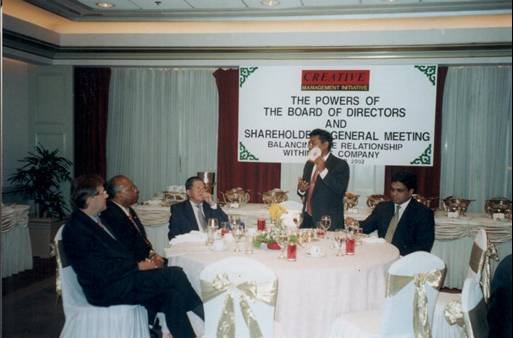
Siddha Param presenting, "Towards Best Practices and Ethical Standards" for managers of GUTHRIE, a leading Palm Oil Plantation Group.
Launch of “Corporate Governance Program” by Dato Liew Sip Hon, former Malaysian Ambassador to the United States of America. (Right of Siddha Param who is standing)

Thursday, March 29, 2007

GLOBAL TRADE

INTERNATIONAL BUSINESS TRANSACTIONS
Human Relationship challenges in Global Trade

With increasing numbers of Asian manufacturers looking to export to North America, the issues and challenges that need to be understood by both Asian and North American parties are:

Negotiating International Sales Contracts
The question that must be addressed by the Parties is, "Can the manufacturer's operational capacity and capability deliver according to the terms of the buyers, "standard sales contract" in terms of quality, quantity, packaging and delivery.

Handling Disputes and Differences
In handling disputes Parties need to designate specific personnel and/or a department to handle and resolve disputes that arise. Clear steps need to be in place on how to establish facts and determine what constitutes sufficient evidence to prove or disprove allegations and arrive at practical solutions.

Good Teleconferencing Practices and Business Cultural Differences
Due regard must be given to understanding business cultural differences. A methodology for setting the agenda and rules of meeting need to be included in the "dispute resolution clause" within the standard sales contract.

Communication Styles
Allowance needs to be given for the different communication styles of individuals. In this regard an understanding of the work designation of individuals involved and their position within their organisational hierarchy need to be understood. For instance, a CEO of a small manufacturer may feel belittled by a middle level purchasing manager of a huge multinational buyer insisting on his point of view resulting in a dispute that arises not out of the business transaction but rather from a personality clash.

Business efficacy demands that parties do their homework on the track record, capacity, capability and business culture of their business partners in international trade. This information and knowledge must be taken into account in the drafting of "standard sales contracts".

Advise on and the sharing of "modern management practices" with business partners can go a long way in establishing long term profitable relationships.

Siddha Param
Corporate Consultant

siddhanet@yahoo.co.uk

Monday, June 19, 2006

THE ETHICS BASED COMPANY
Right Action and Right Behavior

When does football become foot-brawl? The answer is when organizers, players or spectators (consumers) don’t play by the rules. The sport with the greatest following in the world is now in full swing in Germany 2006. This is a multi-billion dollar industry that entertains and promotes an ethical lifestyle!

It works because the whole world guided by the top leadership of an international federation working through national organizations has succeeded in standardizing universal rules of behavior.

This industry illustrates to us the fact that the more ethical the organization the more healthy and profitable it becomes. Fair play is definitely the way forward.

Applying these universal principles to Companies can be achieved in the following manner:

1. Top Leadership – The Chairman and Board of Directors together with the Chief Executive Officer and the Senior Management Team should set out the Values and Ethical Standards of conduct for the Company – Provide standardized universal values content

2. Chief Compliance and Ethics Officer – The CCEO should then transmit these values down the line by providing training and support for middle managers who can utilize – “Situational Role-play Workshops” software provided to transmit and internalize these universal values amongst employees.

3. The CCEO should then electronically send out evaluation questionnaires to employees who can then provide feed-back answers electronically along with suggestions and difficulties faced in daily work situations.

4. The CCEO should then discuss with respective Middle Managers and provide an Ethics Report feed-back to the Chairman, Board of Directors and C.E.O.

5. Top Leadership should then act on this feed-back and recommendations in the Ethics Report incorporating action taken in the Company’s Annual Report so that the market can understand and voice its’ approval through increased share value.

Compliance and Ethics practice and monitoring combines human resource management with legal professional skills in shaping organizational behavior.

The In-house lawyer’s privilege – may help Companies create “space for privileged, private and confidential advice” for internal self-regulation and solution by the Board of Directors hence fulfilling the essence of Corporate Governance.

The US Supreme Court explained the rationale for the attorney-client privilege in HUNT V BLACKBURN (1888), observing that the privilege is ‘founded upon the necessity, in the interest and administration of justice, of the aid of persons having knowledge of the law and skilled in its practice, which assistance can only be safely and readily available of when free from the consequences or the apprehension of disclosure.”

Another relent decision of the US Supreme Court is the case of ARTHUR ANDERSEN LLP v. UNITED STATES which stated, “The jury instructions failed to convey the requisite consciousness of wrongdoing. …. A “knowingly . . . corrupt persuader” cannot be someone who persuades others to shred documents under a document retention policy when he does not have in contemplation any particular official proceeding in which those documents might be material. 374 F. 3d 281, reversed and remanded.” By REHNQUIST, C. J., who delivered the opinion for a unanimous Court.

This stresses the importance for Companies to have clearly written policies, guidelines and codes that instruct employees on what constitutes right action and behavior.


Siddha Param
LL.B. (Hons.)(London), CLP (M)
Corporate Consultant

Mobile: 017 884 6216


E-mail: siddhanet@yahoo.co.uk

Monday, March 06, 2006

CREATING A SELF REGULATING
HUMAN AND FINANCIAL PROFIT CENTRE
Corporate Compliance and the Board of Directors

Corporate governance allows the Chairman and Directors to control and provide leadership thus ensuring that the Corporation remains a self-regulating and self-perpetuating Centre for Financial and Human PROFIT.

The formula for good governance is, People + Passion + Performance = PROFIT

A Company founded on ethical business conduct generates productivity and creates a loyal consumer base. As law and business practices change over time, it is necessary for a Company to review its documentation of business transactions and operations periodically, in line with current legal, industry and consumer expectations and values.

Has your Company reviewed its "Standard Documentation" for business?

It is important to:
A. Document evidence of performance of business transactions by your Company; and,
B. Document evidence of performance by individual employees within your Company

Periodic review of existing work flow documentation, and corporate compliance practices can help you identify, define and implement policies on leadership and control by the Board of Directors and Management Team within your Corporation more effectively.

To ensure effective monitoring and control of your Company’s business it is important to have a Code of Corporate Compliance and Standards of Ethical Conduct.

The Code should set out permitted conduct in carrying out company business promoting efficiency and productivity.

There should additionally be a Corporate Social Responsibility Statement, to set out your Company's commitment on quality and conduct to suppliers, consumers and the community

These essential Instruments can improve staff performance and, promote greater consumer confidence.

Siddha Param
Corporate Consultant

siddhanet@yahoo.co.uk

Thursday, September 29, 2005


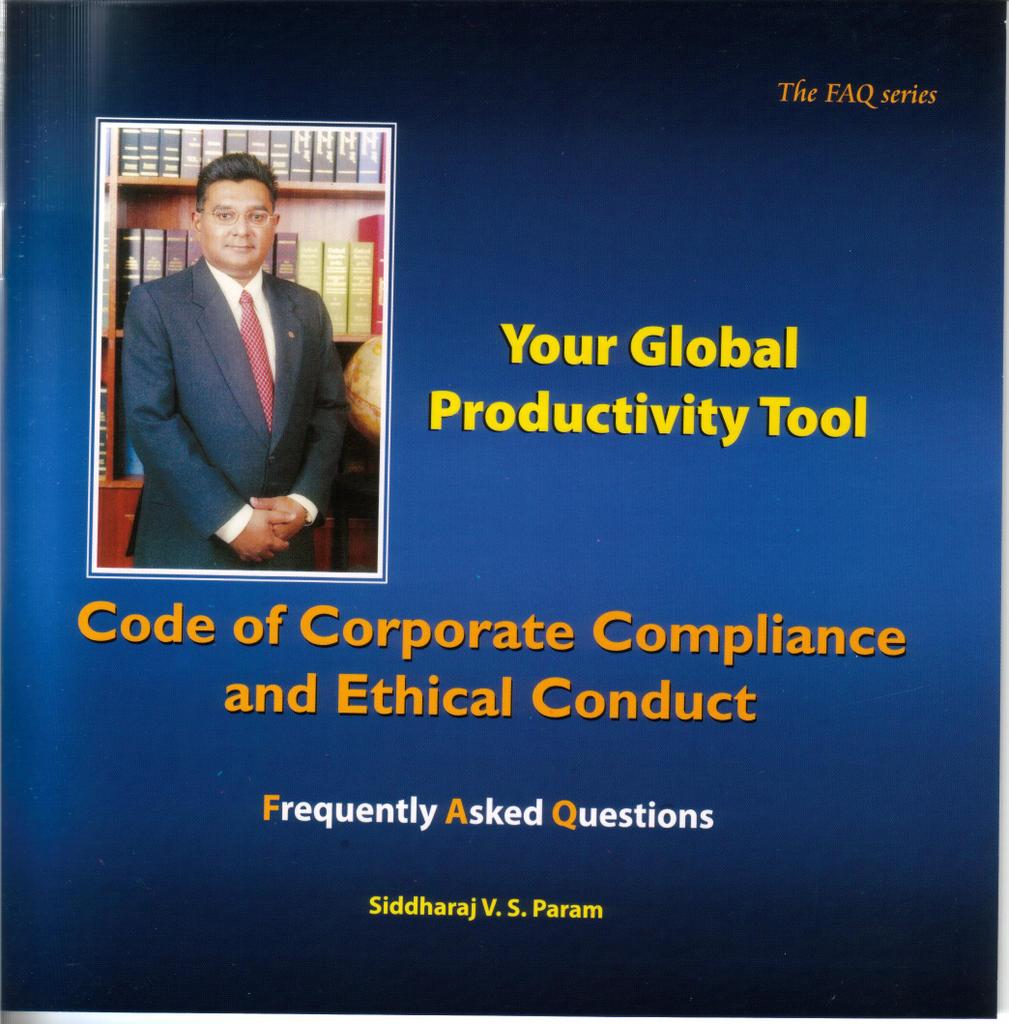
SAMPLE PAGE and BOOK COVER
E-mail siddhanet@yahoo.co.uk for book purchase and FREE TEA TALK.

Sunday, September 25, 2005

CORPORATE CONDUCT

THE CODE OF CORPORATE ETHICAL CONDUCT
A Global Productivity Tool!


An effective Code of Corporate Ethical Conduct (Code of Conduct) seeks to shape corporate culture and organisational behaviour through the setting of clear guidelines on right and wrong action for the directors, managers and staff in a company thereby improving work attitude. The challenge is to prevent corporate wrongs from destroying companies.

A point to ponder on is the fact that corporate scandals from the East India Company to Barings, Enron and beyond have essentially been about failures of human conduct and hence ethics. So, a critical component of management in a global economy must be internal regulation within the corporation utilising a Code of Conduct. The board of directors is the first line of regulation for a company and the Code of Conduct is an instrument for regulation.

A Code of Conduct can be an effective instrument for productivity and the promotion of consumer confidence. It is people motivated with passion for productivity that generates profits and creates a prosperous company and community.

Topics that are covered in an effective Code of Conduct include:

Corporate Governance
Directors, managers, officers, agents and staff of the Company must always act in the best interest of the Company.

Standards of Ethical Conduct
Integrity must be the underlying factor in all internal and external transactions and relationships.

Corporate Communications and Records Retention
An employee shall assume that all communication to, with, for and on behalf of the Company are the property of the Company.

Liabilities in Sales Transactions
All representations made to outside parties by employees in reference to products must be in compliance with the company’s information on the product.

Duty of Care
To avoid negligence all duties must be carried out with care in accordance with acceptable standards under the law.

Violations and Reporting Procedure
There must be a procedure for employees to report known or suspected work-related events of a questionable, fraudulent, or dishonest nature. The company cannot retaliate against any employee who reports such an event and must keep such reports confidential.

A Code of Conduct helps the company to manage legal compliance and achieve the desired work culture across the company.

The five critical elements for an effective Code of Conduct are:

1. It must reflect legally sound advice.
2. There must be monitoring of acceptance by staff.
3. There must be a procedure of reporting to the board of directors.
4. It must be in plain business English with appropriate language translations.
5. It must be implemented throughout the company.

To be truly effective, it is extremely important that the Code of Conduct be written in a way that allows all staff to understand what is required from them. It should be in a style that projects a world class corporate culture.

Such a Code of Conduct when reflected in the annual report can have a positive impact on share value.

Siddha Param
Corporate Consultant
E-mail: siddhanet@yahoo.co.uk

Author:
The Code of Corporate Compliance and Ethical Conduct
– Frequently Asked Questions

Published by CMI Consulting Sdn. Bhd.
First Edition 2005
ISBN 983-42564-0-X