THE ETHICS BASED COMPANY
Right Action and Right Behavior
When does football become foot-brawl? The answer is when organizers, players or spectators (consumers) don’t play by the rules. The sport with the greatest following in the world is now in full swing in Germany 2006. This is a multi-billion dollar industry that entertains and promotes an ethical lifestyle!
It works because the whole world guided by the top leadership of an international federation working through national organizations has succeeded in standardizing universal rules of behavior.
This industry illustrates to us the fact that the more ethical the organization the more healthy and profitable it becomes. Fair play is definitely the way forward.
Applying these universal principles to Companies can be achieved in the following manner:
1. Top Leadership – The Chairman and Board of Directors together with the Chief Executive Officer and the Senior Management Team should set out the Values and Ethical Standards of conduct for the Company – Provide standardized universal values content
2. Chief Compliance and Ethics Officer – The CCEO should then transmit these values down the line by providing training and support for middle managers who can utilize – “Situational Role-play Workshops” software provided to transmit and internalize these universal values amongst employees.
3. The CCEO should then electronically send out evaluation questionnaires to employees who can then provide feed-back answers electronically along with suggestions and difficulties faced in daily work situations.
4. The CCEO should then discuss with respective Middle Managers and provide an Ethics Report feed-back to the Chairman, Board of Directors and C.E.O.
5. Top Leadership should then act on this feed-back and recommendations in the Ethics Report incorporating action taken in the Company’s Annual Report so that the market can understand and voice its’ approval through increased share value.
Compliance and Ethics practice and monitoring combines human resource management with legal professional skills in shaping organizational behavior.
The In-house lawyer’s privilege – may help Companies create “space for privileged, private and confidential advice” for internal self-regulation and solution by the Board of Directors hence fulfilling the essence of Corporate Governance.
The US Supreme Court explained the rationale for the attorney-client privilege in HUNT V BLACKBURN (1888), observing that the privilege is ‘founded upon the necessity, in the interest and administration of justice, of the aid of persons having knowledge of the law and skilled in its practice, which assistance can only be safely and readily available of when free from the consequences or the apprehension of disclosure.”
Another relent decision of the US Supreme Court is the case of ARTHUR ANDERSEN LLP v. UNITED STATES which stated, “The jury instructions failed to convey the requisite consciousness of wrongdoing. …. A “knowingly . . . corrupt persuader” cannot be someone who persuades others to shred documents under a document retention policy when he does not have in contemplation any particular official proceeding in which those documents might be material. 374 F. 3d 281, reversed and remanded.” By REHNQUIST, C. J., who delivered the opinion for a unanimous Court.
This stresses the importance for Companies to have clearly written policies, guidelines and codes that instruct employees on what constitutes right action and behavior.
Siddha Param
LL.B. (Hons.)(London), CLP (M)
Corporate Consultant
Mobile: 017 884 6216
E-mail: siddhanet@yahoo.co.uk

StrandRidge.com Business Updates
Monday, March 06, 2006
CREATING A SELF REGULATING
HUMAN AND FINANCIAL PROFIT CENTRE
Corporate Compliance and the Board of Directors
Corporate governance allows the Chairman and Directors to control and provide leadership thus ensuring that the Corporation remains a self-regulating and self-perpetuating Centre for Financial and Human PROFIT.
The formula for good governance is, People + Passion + Performance = PROFIT
A Company founded on ethical business conduct generates productivity and creates a loyal consumer base. As law and business practices change over time, it is necessary for a Company to review its documentation of business transactions and operations periodically, in line with current legal, industry and consumer expectations and values.
Has your Company reviewed its "Standard Documentation" for business?
It is important to:
A. Document evidence of performance of business transactions by your Company; and,
B. Document evidence of performance by individual employees within your Company
Periodic review of existing work flow documentation, and corporate compliance practices can help you identify, define and implement policies on leadership and control by the Board of Directors and Management Team within your Corporation more effectively.
To ensure effective monitoring and control of your Company’s business it is important to have a Code of Corporate Compliance and Standards of Ethical Conduct.
The Code should set out permitted conduct in carrying out company business promoting efficiency and productivity.
There should additionally be a Corporate Social Responsibility Statement, to set out your Company's commitment on quality and conduct to suppliers, consumers and the community
These essential Instruments can improve staff performance and, promote greater consumer confidence.
Siddha Param
Corporate Consultant
siddhanet@yahoo.co.uk


Thursday, September 29, 2005

Sunday, September 25, 2005
CORPORATE CONDUCT
THE CODE OF CORPORATE ETHICAL CONDUCT
A Global Productivity Tool!
An effective Code of Corporate Ethical Conduct (Code of Conduct) seeks to shape corporate culture and organisational behaviour through the setting of clear guidelines on right and wrong action for the directors, managers and staff in a company thereby improving work attitude. The challenge is to prevent corporate wrongs from destroying companies.
A point to ponder on is the fact that corporate scandals from the East India Company to Barings, Enron and beyond have essentially been about failures of human conduct and hence ethics. So, a critical component of management in a global economy must be internal regulation within the corporation utilising a Code of Conduct. The board of directors is the first line of regulation for a company and the Code of Conduct is an instrument for regulation.
A Code of Conduct can be an effective instrument for productivity and the promotion of consumer confidence. It is people motivated with passion for productivity that generates profits and creates a prosperous company and community.
Topics that are covered in an effective Code of Conduct include:
Corporate Governance
Directors, managers, officers, agents and staff of the Company must always act in the best interest of the Company.
Standards of Ethical Conduct
Integrity must be the underlying factor in all internal and external transactions and relationships.
Corporate Communications and Records Retention
An employee shall assume that all communication to, with, for and on behalf of the Company are the property of the Company.
Liabilities in Sales Transactions
All representations made to outside parties by employees in reference to products must be in compliance with the company’s information on the product.
Duty of Care
To avoid negligence all duties must be carried out with care in accordance with acceptable standards under the law.
Violations and Reporting Procedure
There must be a procedure for employees to report known or suspected work-related events of a questionable, fraudulent, or dishonest nature. The company cannot retaliate against any employee who reports such an event and must keep such reports confidential.
A Code of Conduct helps the company to manage legal compliance and achieve the desired work culture across the company.
The five critical elements for an effective Code of Conduct are:
1. It must reflect legally sound advice.
2. There must be monitoring of acceptance by staff.
3. There must be a procedure of reporting to the board of directors.
4. It must be in plain business English with appropriate language translations.
5. It must be implemented throughout the company.
To be truly effective, it is extremely important that the Code of Conduct be written in a way that allows all staff to understand what is required from them. It should be in a style that projects a world class corporate culture.
Such a Code of Conduct when reflected in the annual report can have a positive impact on share value.
Siddha Param
Corporate Consultant
E-mail: siddhanet@yahoo.co.uk
Author:
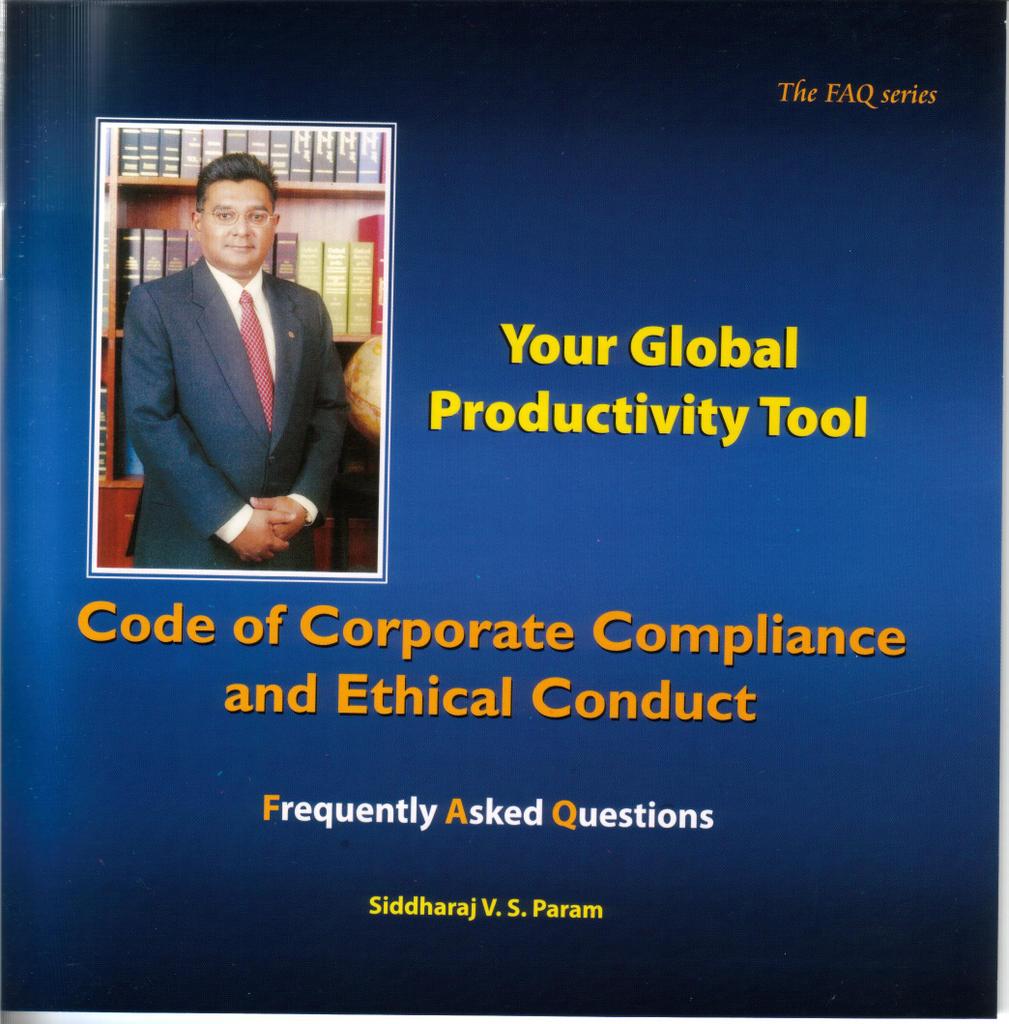
The Code of Corporate Compliance and Ethical Conduct
– Frequently Asked Questions
Published by CMI Consulting Sdn. Bhd.
First Edition 2005
ISBN 983-42564-0-X
Wednesday, July 13, 2005
CONTROL your ASSETS
Preparing Wills & Trust
Do you have a will?
Have you created a trust for your property and assets?
Have you signed any guarantees or documents that expose family property or assets to RISK?
Wills
By making a Will you shall have the ability to decide on how your money, possessions and property are to be divided after your death. A Will also allows you to provide for the care and well-being of children and/or other dependants.
Making a Will enables you to:
Choose just how your property and assets will be distributed after your death.
Appoint a person you know and trust to act as the executor of your estate.
Donate specific things or articles to relatives, friends or charities.
Nominate guardians for any children who may not have reached the age of majority at the time of your death.
Trusts
Trust instruments are generally created to provide for the continuing needs of a spouse, children, grandchildren and/or other dependant relatives.
Siddha Param
Corporate Consultant
siddhanet@yahoo.co.uk
Thursday, July 07, 2005
Maximising The Profit Potential Of Your Intellectual Assets
Protect and capitalize on your Branding and Intellectual property.
Protect and capitalize on your Branding and Intellectual property.
BRANDING
To maximise the potential of your brand name, a clear branding strategy is essential.
Step 1 Identify the businesses intellectual assets.
Step 2 Protect these intellectual assets utilizing the law.
Step 3 Exploit the commercial advantage of your intellectual asset through:
- Licensing;
- Merchandising; and,
- Franchising
in the local and global markets.
The success of a strong brand requires a policy for safeguarding the intellectual asset, dealing with brand disputes and parallel imports.
PROTECTING INTELLECTUAL PROPERTY
Intellectual Property Rights include:
- Inventions;
- Designs;
- A company or business name or trading name;
- A logo;
- Brand name;
- Marketing material;
- Content or design of a Web site, domain names, software; and,
- Content of documents or databases.
Protecting these assets could protect a competitive edge which a business has gained, or could maximise the asset value of the business. This could contribute towards raising financial capital more easily.
Siddha Param,
Corporate Consultant
Wednesday, July 06, 2005

Friday, June 24, 2005
Boutique Boardroom Consultant
CODE OF CORPORATE COMPLIANCE
AND ETHICAL CONDUCT
Your global productivity tool!
THINK ABOUT THIS:
Swiss chocolates come from a country that produces no cocoa. It is human attitude that creates success. The company is merely a vehicle. So watch the driver, not just the vehicle!
To succeed in the global economy it is vital to stay current with changes in international law and business practices. Issues that have to be addressed include; Standards of Ethical Business Conduct; Communications and Records; and, Corporate Governance
To succeed your organization must:
1. Prepare a CODE OF CORPORATE COMPLIANCE AND ETHICAL CONDUCT;
2. Implement the Code through a series of tailored Luncheon Talks, Tea Talks and Training Programmes for the Board of Directors, Managers, and Key Personnel; and,
3. Design, implement and maintain a “Corporate Compliance Solution Software”.
The Code should set out all compliance and ethics issues and act as a consolidating document that brings together and reconciles the various organisational documents and handbooks affecting behaviour and conduct such as:
i) Corporate and Business Objectives of the Company;
ii) Contractual obligations under contracts;
iii) Corporate Governance issues;
iv) Employee Handbook;
v) Operations Manuals;
vi) Legal requirements;
vii) ISO Certification;
viii) Safety Policy;
The Code can act as an effective tool to motivate productivity and ensure an organizational behaviour that reflects the corporate culture, business objectives and good corporate governance practices of the company as set out by the Board of Directors and reflected in the company’s annual report.
The above corporate practice reflected in the Annual Report can have a positive impact on share value.
Siddha Param,
LL. B. (Hons.) (London) CLP (M)
Corporate Consultant
siddhanet@yahoo.co.uk
Subscribe to:
Posts (Atom)